1785 is the established starting point of the documented history of the historic “Ochsen”. The 1865 building appraisal, with its wording “alt Ochsen 80 Jahre”, provides additional confirmation of this early date.
Current operating information
Current information about restaurant operations
Our restaurant currently has no regular opening hours. Service for overnight guests is also subject to availability and staffing.
External guests may be served occasionally and at irregular times, depending on availability and staffing. The restaurant may therefore open for only a few hours.
Whether food is available in addition to drinks also depends on availability.
Today’s opening status is shown directly below. Further information about restaurant operations is available in our imprint.
Is our restaurant open today?
Our restaurant is closed today.
When the restaurant is open, you can also tell by the clearly visible “Open” sign in the window.
Our hotel is not affected and remains open as usual. Even when we are unable to offer restaurant service at all times, we are pleased to welcome you as a hotel guest.
Parking spaces at the property:
The parking spaces at the property are for hotel use. Regardless of whether the restaurant is open or closed, they are not available as public parking and are needed for our overnight guests.
Important notice: Active butchery operations are currently suspended
The butchery has not been deregistered. For staffing reasons, shop sales, production and slaughtering are suspended until further notice. There are currently no sales, including through the restaurant. There are also no online sales, no event catering or other catering services and no production.
Current hotel operation: 8 guest rooms
Today, the main focus of the business is our hotel operation with 8 guest rooms. Room enquiries, reservations and arrival arrangements are handled exclusively by telephone and in German. E-mail is intended for general enquiries only.
Sources and historical assessment
The documented history of the historic “Ochsen” begins in 1785. A building appraisal from 1865, which describes the property as “alt Ochsen 80 Jahre” (“old Ochsen, 80 years”), provides additional confirmation of this early dating. In 1804, Georg Dannenmann is explicitly named as “Ochsenwirt”, the innkeeper of the Ochsen. The documented history of the house also includes its own agriculture and the sale of sausages and other processed meat products. In 1873, Wilhelm Raabe explicitly mentioned the “Ochsen zu Hohenstaufen” in his novel Christoph Pechlin.
Not every detail of everyday working life survives in business records. This page therefore distinguishes between direct evidence relating to the house, regional historical context and careful interpretation. The distinction makes clear which statements belong directly to the history of the Ochsen and which explain the wider economic and social setting.
Georg Dannenmann is explicitly identified in a surviving record as “Ochsenwirt”.
The house had its own fields, meadows, orchards and woodland, as well as cattle, pigs and chickens. Surviving records relating to the house also document garden produce, eggs, milk, butter, a private well, the distillation of spirits and the sale of sausages and other processed meat products.
1. Evidence and source criticism
The early history of the house rests on several different types of evidence. It is particularly important to distinguish records that relate directly to the Ochsen from broader regional history.
Directly documented for the “Ochsen”
- documented beginning of the history of the historic “Ochsen” in 1785; the 1865 building appraisal describes the property as “alt Ochsen 80 Jahre”
- Georg Dannenmann expressly identified as “Ochsenwirt” in 1804
- the house’s own agriculture, including fields, meadows, orchards and woodland
- livestock keeping with cattle, pigs and chickens, together with the house’s own eggs, milk and butter
- vegetable growing, a private well and the distillation of spirits as part of the documented system of self-sufficiency
- production and/or sale of sausages and other processed meat products
- archive finding aid B 2/908: “Christian Seitz jg., Wirt zum Ochsen”; the archival unit’s date range 1897–1907 is not the same thing as his exact operating period
- documented succession of operators: Jung Christian Seitz 1894–1906
- early telephony: surviving material records the “Ochsen” with “Telefon Nr. 2” before Karl Mayer’s documented period began; the number therefore cannot be used to date the start of his tenure
- Wilhelm Raabe’s literary reference to the “Ochsen zu Hohenstaufen” in Christoph Pechlin (1873)
Regional context and cautious interpretation
- municipal livestock figures from the 1840 survey
- sales at the livestock markets of 1838
- cattle trading and fattening in Hohenstaufen as described in the 1844 Oberamt survey
- difficult road conditions on the ascent between Göppingen and Hohenstaufen
- Hohenstaufen’s development into a place associated with historical commemoration and day-trip tourism during the 19th century
- the general operation of rural multi-purpose businesses combining hospitality, agriculture and meat processing
Why this distinction matters
A pattern that was typical of the region can help to interpret surviving evidence relating to the house, but it cannot replace direct documentation. Established facts about the Ochsen are therefore kept separate from broader historical context and plausible interpretation.
House and building records
Hohenstaufen local archive
Oberamt survey of 1844
Literature: Wilhelm Raabe
Economic and social history of Württemberg
2. Chronological overview
This timeline combines direct evidence relating to the house with regional developments. References to the wider setting are explicitly intended as context.
1785 · The historic “Ochsen”
1785 is the established starting point of the documented history of the historic “Ochsen”. A later building appraisal from 1865 describes the property as “alt Ochsen 80 Jahre” and provides additional confirmation of the early date.
1804 · Georg Dannenmann as “Ochsenwirt”
A surviving note dated 15 September 1804 expressly identifies Georg Dannenmann as “Ochsenwirt”. The inn is therefore directly documented by this date.
1816/17 · Years of hunger and crisis
The climatic effects of the “Year Without a Summer” hit Württemberg with crop failures, rising prices and food shortages. Such years placed substantial strain on agricultural businesses.
1833 · Hohenstaufenverein
Organised engagement with Staufer history increased public awareness of the mountain and the village.
1838 · Important livestock market
At the Hohenstaufen livestock market, 558 oxen and bulls, 126 cows and 52 animals recorded as “Schmalvieh” were sold. These figures refer to market sales, not to the local livestock population.
1840/1844 · Livestock figures and the Oberamt survey
The 1840 survey records 78 oxen and bulls over two years old, 271 cows and 157 animals in the category “Schmalvieh” for Hohenstaufen. The Oberamt description published in 1844 also identifies Hohenstaufen as a place of cattle fattening and significant cattle trading.
From 1859 · Church and Staufer commemoration
The growing historical significance attached to the church, mountain and village probably brought additional day visitors to local inns as well.
1873 · Wilhelm Raabe: Christoph Pechlin
The novel explicitly names the “Ochsen zu Hohenstaufen” and uses it as the setting for a wedding and inn scene.
Before 1907 · “Telefon Nr. 2”
Surviving historical material records the “Ochsen” with “Telefon Nr. 2” before Karl Mayer’s documented period as operator began. This is important for the chronology: the telephone number belongs to the predecessor period and cannot be used as evidence that Karl Mayer was already running the business before 1907.
1894–1906 · Jung Christian Seitz
According to the documented succession of operators, Jung Christian Seitz ran the “Ochsen” from 1894 to 1906. A finding-aid entry names “Christian Seitz jg., Wirt zum Ochsen”; the archival unit’s date range of 1897–1907 must not be confused with his exact operating period.
Before 1900 · An interconnected household business
The house’s own agriculture and the sale of sausages and other processed meat products are established parts of its history. The household economy also included fields, meadows, orchards and woodland, cattle, pigs and chickens, and a broad system of self-sufficiency. The starting date of every individual activity is not documented with equal precision.
3. Early development, building form and operating logic
The rural inn as a multi-purpose business
The historic “Ochsen” cannot usefully be understood as an isolated inn. Hospitality, the house’s own farming and the sale of sausages and other processed meat products are established parts of its history. Surviving family and house records also document fields, meadows, orchards and woodland, together with cattle, pigs and chickens. This combination corresponded to a widespread rural model in which supply, processing and hospitality were closely connected.
A business relying solely on food, drink or accommodation could be vulnerable in a mountain village where demand was seasonal, transport difficult and agriculture uncertain. A mixed operation could spread risk: if one part of the household economy performed poorly, other activities could help absorb the pressure. Agriculture, livestock keeping, food processing and hospitality therefore offered a broader economic base than any single activity on its own.
Architectural context
Historic multi-purpose buildings of this kind often brought living space, storage, food processing and hospitality under one roof. Large roof spaces could be used for supplies, substantial cellars for cool storage, and robust stairs and load-bearing walls for heavy loads. In buildings of this kind, solid construction was primarily practical rather than decorative.
Ground-floor and ancillary areas may have been used particularly intensively for business: dining room, kitchen areas, storage and work rooms, with access connected to deliveries or livestock. Upper floors were more likely to have carried residential and accommodation functions. Such historic room arrangements can continue to influence a building long after later alterations.
The house as a node in local movement
An inn in a topographically demanding location such as Hohenstaufen was not important only to the village itself. It formed part of a wider pattern of movement between village, market and town. Travellers could need a meal, a place to sleep, shelter for an animal, or simply somewhere to wait for weather conditions to improve and exchange information.
Interpretive principle: before 1900, the Goldener Ochsen’s predecessor is best understood as a rural centre of self-sufficiency, processing and hospitality – not as a single-purpose hotel in the modern sense, but as a place where several practical needs came together.
4. Topography, the ascent and transport geography
Seven kilometres was a significant journey
The distance between Göppingen and Hohenstaufen seems modest today. Before 1900, however, it represented a real expenditure of time and effort depending on weather, time of day and load. Travel relied on animal power, walking and roads whose condition was strongly weather-dependent. Every uphill kilometre mattered to a heavily loaded cart.
The climb as a practical constraint
Historical descriptions of local roads make clear that the climb to Hohenstaufen was not an easy approach. A steep road placed considerable demands on animals, vehicles, carters and travellers. Rain, mud, snow and ice increased the effort and risk and could make the route extremely difficult at certain times of year.
For an inn at the end of such an ascent, this difficulty could itself create demand: where the terrain forced people to stop, there was a need for food, warmth, drink, shelter for animals and accommodation. The location was therefore not only a disadvantage but also part of the economic setting in which the inn operated.
The inn as a stopping point
Although complete business records do not survive for every year, it is historically plausible to view the “Ochsen” as a place where travellers could do more than eat: they might rest animals, recover from the journey, wait for the weather, exchange information, make contacts and, where required, stay overnight.
A useful position within the local road network
Hohenstaufen was not situated on a major long-distance trade route, but it was a destination regularly approached from Göppingen: for livestock-market business, church occasions and, later, history-focused day trips. Each of these activities generated movement and therefore needs that a well-run inn could serve.
Topography as an economic factor
The mountain village’s location shaped its inns. Difficult roads, market visits, church occasions and later day-trip tourism could all create demand for rest, food and accommodation. For the “Ochsen”, the location was therefore both an obstacle and part of its economic environment.
5. Agrarian economy, livestock and the livestock market
The 1844 Oberamt description contains two different kinds of figures that must not be confused: the local livestock population recorded in the 1840 survey and the sales at livestock markets in 1838.
Livestock population recorded in 1840
| Locality | Oxen and bulls over 2 years | Cows | Schmalvieh |
|---|---|---|---|
| Hohenstaufen | 78 | 271 | 157 |
| Göppingen | 15 | 386 | 157 |
| Uhingen | 72 | 308 | 166 |
| Albershausen | 68 | 164 | 82 |
Sales at selected livestock markets in 1838
| Livestock market | Oxen and bulls | Cows | Schmalvieh |
|---|---|---|---|
| Ebersbach | 953 | 565 | 72 |
| Hohenstaufen | 558 | 126 | 52 |
| Heiningen | 109 | 99 | 9 |
| Uhingen | 53 | 102 | 53 |
Source: Rudolph Friedrich von Moser, Beschreibung des Oberamts Göppingen, Stuttgart and Tübingen 1844; livestock population from the 1840 survey and the note on livestock-market sales in 1838.
What the figures actually show
Hohenstaufen did not have 558 oxen and bulls as its local livestock population in 1840. The figure 558 refers to oxen and bulls sold at the Hohenstaufen livestock market in 1838. The local population in 1840 was 78 animals in this category.
Livestock trading and cattle fattening
The Oberamt description expressly identifies Hohenstaufen as a place where cattle were fattened and lists its annual market among the district’s important cattle-trading markets. This provides a solid economic background for a historic house with its own agriculture, hospitality and sausage sales.
6. Early telephony and the historic “Telefon Nr. 2”
A short telephone number with historical value – and clear limits
The later 19th-century history of the house also includes early telephone access. Surviving material records the “Gasthaus und Metzgerei z. Ochsen” with the striking notation “Telefon Nr. 2”. Very short numbers of this kind belonged to early local telephone systems and are an instructive reminder of the technological changes taking place at the time.
One point is particularly important for the chronology of the operators: Telephone No. 2 is already documented for the period before Karl Mayer. It must therefore not be used as evidence that Karl Mayer was running the “Ochsen” in 1903 or 1906. In this account, 1907 remains the documented starting year of his tenure; earlier dates, where they appear in other material, are treated as conflicting source information rather than silently merged into the chronology.
What “Telefon Nr. 2” tells us – and what it does not
It documents early telephone access at the “Ochsen” during the predecessor period. The low number alone does not prove that this was the second telephone connection in the wider region, nor does it date a particular change of operator. Its main value here is as evidence of early local communications technology.
The telephone number continued to evolve in the 20th century, with later forms including 262 and eventually 8062. That later development belongs mainly to the history from 1900 onward.
7. Livestock trade, markets and the inn as a place of negotiation
The inn as a place for business
In an age without telephones, bank accounts or commercial registers in the modern sense, business was often conducted across a table. A village inn was not only a place to rest; it could also provide space for negotiation, price discussions and transport arrangements. In south-west Germany, the “Leikauf” – a drink marking the conclusion of an agreement – was a social practice with practical economic significance.
For inns in a livestock-market setting, this could create additional economic value: alongside food and drink, the inn offered a sheltered place for conversation and negotiation. This connection is historically plausible for the “Ochsen”, although no detailed accounts of such individual market transactions survive.
Market days and seasonal demand
Hospitality before 1900 was strongly seasonal. Winter brought less through traffic; summer generally brought more. Market dates could produce far more business on a single day than a quiet week. An inn prepared with sufficient supplies, seating and an effective kitchen was better placed to benefit from such peaks in demand.
The meaning of the name
The name “Ochsen” fits naturally into the agricultural environment of the late 18th and 19th centuries. Oxen were important draught animals, slaughter animals and animals traded on regional livestock markets. The name alone does not prove that this was the precise reason for the choice of house name, but linguistically and economically it fits the historical setting of Hohenstaufen remarkably well.
8. Butchery and sausage sales in the history of the business
Historically established: agriculture, livestock and sausage sales
The house’s own farming and the sale of sausages and other processed meat products are documented parts of its history. Surviving records also mention fields, meadows, orchards and woodland, together with cattle, pigs and chickens and a broad system of self-sufficiency. Each activity must nevertheless be dated separately: the surviving evidence does not take every branch of the business equally far back.
More than a sideline
In the history of the “Ochsen”, meat and sausage processing was closely connected with agriculture, livestock keeping and hospitality. It formed an important part of the house’s economic chain: animal products from the household or the surrounding region could be processed, preserved and used or sold as food.
Butchery made it possible not only to provide fresh meat but also to turn animal products into forms that could be stored, transported and sold more effectively: cured meat, sausages, smoked products and provisions. Each processing step kept more of the value creation within the household business.
Processing as well as slaughter
The economic advantage lay in processing and preservation. For a connected household business, it was logical to link kitchen, stores and sausage sales closely. The exact dishes served in every early period are not fully documented.
Substantial meat dishes, soups, broths, stews and processed meat products were well suited to travellers engaged in physical work – cattle traders, carters, walkers, market visitors and labourers. Hospitality depended in part on providing what people needed after a demanding journey.
Skills before modern refrigeration
Before electric refrigeration, meat processing required considerable practical knowledge. Salt, smoke, airflow, season, room temperature and experience all affected keeping quality. Much of this knowledge was transmitted through family and craft practice rather than written manuals.
Seasonal patterns of slaughter and processing
Before industrial refrigeration, the calendar strongly influenced slaughtering practice. Larger slaughtering operations were favoured in colder months, when meat remained naturally cooler. Butchery therefore followed a seasonal rhythm, with different working patterns in autumn and winter than in summer, when fresh products had to be used more quickly.
9. Kitchen, stores and self-sufficiency
Self-supply from agriculture, garden and household production
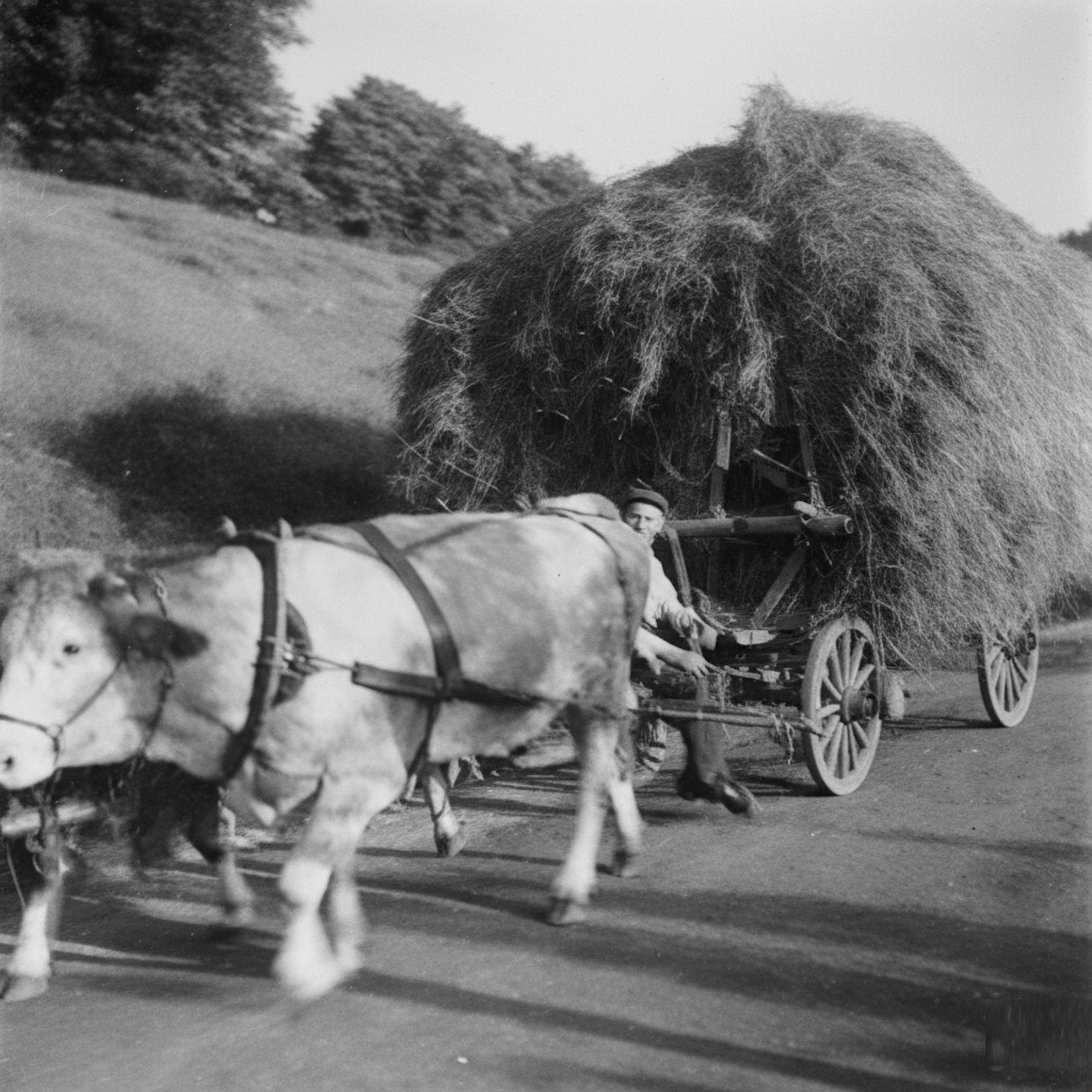
The house’s system of self-sufficiency is well established in the surviving history. Vegetables came from the house’s own garden and were supplemented by purchase or exchange when necessary. Grain came from the house’s own fields or was likewise obtained through exchange. The agricultural property included fields, meadows, orchards and woodland.
Livestock included cattle and pigs as well as chickens. The household produced its own eggs, milk and butter. A private well and the distillation of spirits are also part of the surviving house history. Supply therefore rested on a broad combination of own production, storage, exchange and supplementary purchasing.
Household provisions and food for guests
The close connection between agriculture, storage, meat and sausage processing and the kitchen allowed the house to supply itself flexibly. Home-produced food could serve the family and the business, while purchasing and exchange supplemented what was not available in sufficient quantity. No complete menu or purchasing books survive for the early period to document every individual use.
Food storage as an essential task
For rural inns in the 19th century, keeping supplies was an important part of annual planning. Dried or salted meat, preserves, sausage stocks, flour and fats could help bridge seasonal fluctuations. At the “Ochsen”, this general economic pattern fits particularly well with the documented combination of agriculture, livestock, self-sufficiency and sausage sales.
10. Crisis years, hunger and resilience
1816/17 as a major test
The hunger crisis of 1816/17 is an important reference point in the history of rural businesses in Württemberg. The “Year Without a Summer” followed the eruption of Mount Tambora in Indonesia in April 1815; its atmospheric effects contributed to crop failures in Central Europe, severe price increases, acute food shortages and a major wave of emigration from Württemberg.
For an agriculturally based business such as the “Ochsen”, such a crisis would have created substantial pressure; detailed house accounts from those years are not currently known. A business depending only on paying travellers would have been especially vulnerable, while a household with fields, livestock, stores and processing had a wider range of resources.
Why mixed rural businesses could be more resilient
Economic diversity was a practical response to uncertainty. A household relying on a single source of income was exposed if that source failed. Combining arable farming, livestock, storage, slaughtering or processing and hospitality could spread risk across several areas. Such a model could not prevent shortage, but it could help absorb pressure from a downturn in one part of the business.
Other periods of strain in the 19th century
1816/17 was not unique. The 19th century brought other periods of agricultural pressure in Württemberg, including the hunger years of 1846/47, livestock disease and the wider uncertainty associated with the transition from subsistence-oriented to increasingly market-oriented agriculture.
Interpretation: the house’s long-term stability is likely to have depended less on sentiment than on economic diversity. Several interconnected activities gave a rural household more ways to absorb disruption.
11. Staufer memory, the Hohenstaufenverein and early tourism
From mountain village to a place of historical interest
During the second half of the 19th century, Hohenstaufen changed not only economically but symbolically. The village and mountain were increasingly viewed through their association with the Staufer dynasty. Medieval enthusiasm, national historical narratives and regional identity gave the mountain a cultural significance beyond everyday village life.
The Hohenstaufenverein
The Hohenstaufenverein, founded in 1833, gave this historical interest an organised form. The society promoted attention to Staufer sites and helped make the mountain better known beyond the immediate region. Greater visibility meant more potential visitors for local hospitality businesses.
The Barbarossa Church as a cultural attraction
The local church also became increasingly connected with the historical symbolism surrounding Hohenstaufen. Visitors interested in the Staufer past encountered not only ruins and the mountain skyline but also places of interpretation, symbolism and rest.
Possible changes in the clientele
For local inns, including the “Ochsen”, this development probably brought additional visitors. Alongside local residents and business travellers, they may have included day visitors and people with a historical interest in Hohenstaufen. The exact composition of the house’s guest groups is not documented.
Economic effect: new demand alongside the agrarian economy
Growing visitor traffic did not replace the agricultural economy; it developed alongside it. The “Ochsen” remained rooted in a rural household economy while also becoming part of a growing culture of day trips and historical interest. This meant that agricultural activity and visitor demand could overlap rather than simply replace one another.
12. Wilhelm Raabe and the “Ochsen zu Hohenstaufen”
Literary visibility from 1873
The historic “Ochsen” occupies a distinctive place in the cultural record because Wilhelm Raabe names it repeatedly in his novel Christoph Pechlin, published in 1873. Raabe sets an extended part of the story in Hohenstaufen and distinguishes explicitly between two inns in the village: the “Ochsen” and the “Lamm”.
This is particularly interesting for the history of the house because the real “Ochsen” is independently documented in archival material long before 1873. Raabe’s novel is nevertheless a literary source, not an official record. It cannot prove that individual celebrations actually took place or that every architectural detail matched the real building. What it does show directly is that Raabe used the “Ochsen zu Hohenstaufen” as a named and repeatedly described setting.
1. Staying at the “Ochsen” – wedding, music and dancing
Even before the main wedding scene, Raabe explicitly names the “Ochsen” as a possible place to stay and links the inn directly with the celebration:
„Im Ochsen ist Hochzeit, Musik und Tanz, und hineingucken werde ich jedenfalls“
English translation: “There is a wedding, music and dancing at the Ochsen, and I shall certainly go in and have a look.”
Wilhelm Raabe, Christoph Pechlin, chapter 16 · original passage at Projekt Gutenberg
2. “At the Ochsen, not at the Lamm!”
From the castle hill the characters hear the wedding music from the village. Raabe states explicitly which of the two inns is hosting the celebration:
„das Getön der Hochzeit im Ochsen zu Hohenstaufen; – im Ochsen, nicht im Lamm!“
English translation: “the sound of the wedding at the Ochsen in Hohenstaufen – at the Ochsen, not at the Lamm!”
Wilhelm Raabe, Christoph Pechlin, chapter 17 · original passage at Projekt Gutenberg
3. The “Tanzsaal des Ochsen” – the dance hall of the Ochsen
In the following chapter Raabe again contrasts the two inns and explicitly calls the hall at the Ochsen a dance hall:
„Je lustiger und wilder es im Tanzsaal des Ochsen zuging“
English translation: “The merrier and wilder things became in the dance hall of the Ochsen …”
Later official licensing records independently confirm that the Ochsen did in fact contain a hall. They do not, by themselves, prove that it was architecturally the exact room Raabe had in mind in 1873.
Wilhelm Raabe, Christoph Pechlin, chapter 18 · original passage at Projekt Gutenberg
4. Sir Hugh and rooms arranged at the “Ochsen”
For the history of accommodation, Sir Hugh Sliddery is particularly interesting. Raabe places him explicitly at the “Ochsen zu Hohenstaufen” and refers to rooms arranged there:
„Sir Hugh saß … im Ochsen zu Hohenstaufen, allwo er wieder einmal chambers bespoken hatte“
English translation: “Sir Hugh sat … at the Ochsen in Hohenstaufen, where once again he had arranged rooms.”
Elsewhere in the novel, Raabe himself makes clear that chambers bespoken
means rooms that had been engaged or reserved.
Chapter 19: Sir Hugh at the “Ochsen” · chapter 10: Raabe’s use of “chambers bespoken”
5. The “Ochsen” as a closely described celebration venue
In chapter 20 Sir Hugh is again at the Ochsen, seated in the midst of the wedding party. Raabe’s scene refers to the hall, the doorway, tables and the musicians’ platform.
„Da saß er ganz behaglich zwischen dem Brautvater und dem Küster“
English translation: “There he sat quite comfortably between the bride’s father and the sexton.”
Later, the commotion spreads from the hall down the stairs and out in front of the house. Within the Hohenstaufen episode, the Ochsen is therefore described as an unusually vivid setting.
Wilhelm Raabe, Christoph Pechlin, chapter 20 · original passage at Projekt Gutenberg
6. The “Ochsen”, the “Lamm” and the village street
The relationship between the two inns also matters spatially in the story. The wedding party moves out from the Ochsen and through the village street:
„die Hochzeitsgesellschaft aus dem Ochsen … die Dorfgasse“
English translation: “the wedding party from the Ochsen … the village street”.
Raabe therefore treats the “Ochsen” and the “Lamm” repeatedly as two distinct inns whose positions in the village relate to one another.
Wilhelm Raabe, Christoph Pechlin, chapter 22 · original passage at Projekt Gutenberg
What can reasonably be stated as historical evidence? The real “Ochsen” is independently documented in archival sources long before 1873. Raabe explicitly names an “Ochsen zu Hohenstaufen” and associates it, over several chapters, with rooms, a wedding, music, dancing and a dance hall. Those literary references can be checked directly in the text.
What does the novel not prove? It does not prove that the wedding actually took place, that Sir Hugh was a real guest, or that every architectural detail precisely matched the building as it existed at the time. Literary description and official documentary evidence are therefore kept deliberately separate.
The narrative context
Raabe’s Hohenstaufen episode brings travellers, villagers and a wedding party together. The “Lamm” and the “Ochsen” serve as two explicitly named locations in the story. While the wedding at the Ochsen is accompanied by music and dancing, the events become increasingly turbulent.
For the history of the house, the important point is not whether every element of the plot reflects a real event. What matters is that Raabe repeatedly uses the “Ochsen zu Hohenstaufen” as a specific and recognisable location.
Literary interpretation and historical limits
From a literary perspective, the Ochsen can be read as a setting in which different characters and social groups meet. For the real history of the business, however, the repeated naming of the place is the secure core of the evidence. The novel alone cannot establish the actual clientele, social profile or day-to-day operation of the historical inn.
13. The “Ochsen” in village life
More than a place to eat and drink
In smaller communities, the dining room of an inn could be an important place of communication. News was exchanged, contacts made, information from Göppingen and beyond passed on, prices discussed, services arranged and disputes negotiated. Before widespread telephones, notice boards and daily newspapers, the inn was one of the places where information naturally came together.
Informal administration and sociability
Where village public life did not take place in modern municipal buildings, an inn could acquire a semi-public role. It was accessible, heated, familiar and connected with food and drink. Local officials, clergy or market supervisors might use such spaces for conversations that were more public than a private household but less formal than an official office.
Clubs, celebrations and larger rooms
Organised associations became increasingly important during the 19th century. Shooting clubs, singing societies, agricultural associations and gymnastics clubs all needed meeting space. Inns with larger rooms or halls could benefit from weddings, meetings, rehearsals and celebrations, creating additional demand for food, drink and space.
Inns as points of contact for visitors
For people unfamiliar with a village, inns were among the most important public places to find food, wait, obtain information and, where offered, stay overnight. Hohenstaufen had several inns, including the “Ochsen” and “Lamm” known from Raabe’s literary account. The “Ochsen” was therefore part of the village infrastructure that brought local residents and visitors into contact.
14. Short glossary
Schildwirtschaft
A historical German term for a licensed inn entitled to serve travellers and, depending on the licence, sometimes to provide accommodation. The general meaning of the term does not by itself establish exactly when or under which licence the “Ochsen” operated.
Schmalvieh
A historical livestock category used in official statistics for younger or smaller cattle in contrast to fully grown animals. In the 1844 Oberamt description, it is listed separately from “oxen and bulls over two years”.
Veredelungsmast
The deliberate fattening of lean cattle purchased for the purpose of increasing their value before resale or slaughter. In the Hohenstaufen context, this helps explain the unusually strong role of fully grown oxen in the local livestock economy.
Steige
A rising road or path, often difficult in steep terrain and bad weather. In Württemberg usage, the term commonly described ascents that placed demands on vehicles, draught animals and people travelling on foot.
Leikauf
A drinking custom known in south-west Germany that could symbolically confirm a concluded bargain. Accepting the drink helped give the agreement social and practical force.
Oberamtsbeschreibung
An official statistical and geographical description of an administrative district in the Kingdom of Württemberg. The series is an important primary source for the economic and social history of rural communities in the 19th century.
15. Continuity, family and the transfer of knowledge
Why rural businesses rarely survive without adaptation
A house does not continue for centuries simply because its walls remain standing. Knowledge, relationships, reputation and a practical understanding of the business must also be transferred. A closed inn can be taken over by someone else, but regular customers, supplier relationships and craft knowledge cannot be replaced as easily.
The “Ochsen” brought together many different areas of expertise: agriculture, storage, livestock procurement, butchery, hospitality, pricing, knowledge of local customers and dealing with visitors from outside the village. Such a combination is difficult to replace from outside.
Reputation as an intangible asset
An inn depends not only on buildings but also on trust. People choosing where to eat, trade, celebrate or stay overnight relied on reputation, particularly in rural areas where personal and family relationships mattered greatly.
Generational change: risk and opportunity
Every change of generation in a family business brings both risk and opportunity: knowledge, working style and networks must be transferred, but a new generation can also adapt the business to changing conditions, new groups of guests and new forms of operation. The later history of the “Ochsen” can be read as a sequence of such transitions.
16. Open questions and further research
Sources that could provide further insight
- licence files or official permissions concerning the inn from the 18th and early 19th centuries
- fire-insurance records and cadastral material documenting changes to the main building
- tax lists, estate books or local accounting fragments from family or parish archives
- church records and family material relating to ownership and name continuity
- early photographs of the hall, the façade or butchery areas
- evidence of market and trading relationships with Göppingen, Ulm or Stuttgart
- records of the Hohenstaufenverein mentioning local inns
- travel descriptions, walking guides or school-excursion reports from the late 19th century mentioning Hohenstaufen
Why further research would be valuable
The denser such small-scale sources become, the more precisely the transition can be described from an inn embedded in an agrarian household economy to a business serving an increasingly important destination for history-focused day trips.
Comparison with other inns of similar size and location would also help distinguish what was typical of rural multi-purpose businesses in the region from what was specific to the “Ochsen”.
17. Sources and further reading
Primary anchor sources
- House and family records of the Goldener Ochsen, including historical documents and photographs relating to agriculture, livestock and the household’s self-sufficiency.
- Building appraisal of 1865 with the wording “alt Ochsen 80 Jahre”.
- Rudolph Friedrich von Moser: Beschreibung des Oberamts Göppingen, Stuttgart/Tübingen 1844.
- Early telephony: surviving historical material recording the “Ochsen” with “Telefon Nr. 2” before Karl Mayer’s documented tenure; the number is therefore not used to date the beginning of his period as operator.
- Wilhelm Raabe: Christoph Pechlin, first published in 1873. Particularly relevant to the history of the house are chapters 16, 17, 18, 19, 20 and 22, together with Raabe’s use of “chambers bespoken” in chapter 10. Direct links and short original passages are documented in the Wilhelm Raabe section.
Regional and cultural-historical context
- Material relating to the history of the Hohenstaufenverein and 19th-century reception of the Staufer dynasty.
- Local and church history of Hohenstaufen, especially the Barbarossa Church and its role in 19th-century historical commemoration.
- Economic and social history of Württemberg in the 18th and 19th centuries, especially rural hospitality and butchery.
How the evidence is assessed
Direct evidence relating to the house, regional sources and broader historical relationships have different evidential weight. Established facts about the “Ochsen” are therefore distinguished from general context and cautious interpretation.
18. Conclusion
Before 1900, the surviving evidence shows that the “Ochsen” was more than simply an inn serving food and drink. It formed part of a multi-purpose rural household economy in which farming, livestock, food processing, hospitality and transport conditions all interacted. Wider regional developments – including periods of crisis, historical commemoration and the beginnings of visitor traffic – provide important context for that history.
That complexity is precisely what makes the history of the house valuable. Its documented household economy included its own fields, meadows, orchards and woodland, cattle, pigs and chickens, as well as garden produce, eggs, milk and butter. Sausage sales, a private well and the distillation of spirits are also part of the surviving history. Hospitality formed the part open to guests of this wider household business, while Hohenstaufen’s growing importance as a destination for history-focused day trips probably brought additional visitors to local inns.
Raabe’s “Ochsen”, finally, is more than a passing literary reference to an individual house. In the novel it becomes a setting in which different characters and social groups meet. For the real history of the business, however, the secure evidence is the repeated naming and description of the “Ochsen zu Hohenstaufen”; broader conclusions about its actual clientele or social role remain literary interpretation.
Continue the chronicle
The following page, History of the Goldener Ochsen from 1900 onward, continues the story from the agrarian multi-purpose household through the end of the house’s own farming in 1960 and into the modern history of the hotel and business.